

One straightforward brand deal can live comfortably in a chat.
The brand sends a brief. You agree on one Reel. A date is mentioned. You send the draft in the same conversation, make one change, post it, and eventually receive the payment. There are not many moving parts, so scrolling upward feels like a system.
Then a second collaboration begins before the first one ends.
Now one brand is waiting for a revised voice-over, another expects three Story frames on Friday, and a third has paid the advance but not the balance. The details still exist, but they are scattered across WhatsApp, email, Instagram DMs, Drive links, calendar reminders, and memory.
That is the point where chat stops being enough—not because WhatsApp is bad, but because a conversation and a project record do different jobs.
We’re the team building BrandMay, a creator-first workspace for managing brand collaborations. This article explains the operating system we believe creators need, whether you use BrandMay, a spreadsheet, or your own setup.
The first deal feels simpler than it really is
Imagine a skincare brand asks a creator, Maya, for one Instagram Reel.
The first conversation covers:
- the idea and product;
- the Reel format and posting date;
- a ₹30,000 fee;
- one revision round;
- an advance before filming;
- the remaining payment after the post goes live.
Maya can remember all of this because it is the only active collaboration. When the brand asks, “Can we move the draft to Monday?”, she understands which draft and which Monday.
But the deal already contains several distinct records:
| Record | The question it answers |
|---|---|
| Scope | What exactly did Maya agree to create? |
| Dates | When are the draft, approval and live post due? |
| Versions | Which file is current, and what changed? |
| Approval | Has the brand approved this version? |
| Money | What was agreed, received and still outstanding? |
Chat hides that structure while the work is simple. It does not remove it.
More deals create collisions, not just more messages
The difficulty does not grow neatly from one deal to two. It compounds because the work overlaps.
Maya’s week might now look like this:
- Brand A: Reel V2 due Tuesday; ₹10,000 advance received.
- Brand B: two Story frames to shoot Wednesday; brief changed in a voice note.
- Brand C: post is live; ₹18,000 invoice due next week.
The loudest conversation can easily replace the most important action. A fresh WhatsApp message from Brand B pushes Brand A’s revision upward in Maya’s attention, even if the revision is due first. Brand C can disappear entirely because there is no active creative work left—only money to collect.
Three problems usually appear together.
Conflicting deadlines
A posting date, draft date and shoot date are not interchangeable. When they live in different chats, creators discover collisions too late.
Ambiguous versions
Files named final.mp4, final-2.mp4, and final-revised.mp4 do not say which version the brand actually reviewed. Feedback copied into a different conversation loses its connection to the file it describes.
Partial payments
“Paid” and “not paid” are not enough. A ₹30,000 deal may have ₹10,000 received and ₹20,000 remaining. The unpaid balance may also have its own due date. If only the bank notification is recorded, the campaign still looks settled in memory when it is not.
A simple system that works without BrandMay
You do not need new software to improve this. Start with one record per collaboration and give every active deal the same structure.
1. Write the agreement as fields, not a paragraph
For every deal, record:
- brand and campaign name;
- paid, barter, free, or mixed compensation;
- each deliverable with format, quantity and platform;
- draft, posting and payment dates;
- usage rights, paid advertising and exclusivity;
- agreed value and payment schedule;
- the single next action.
Do not rely on a long notes field for information you will need to compare later. “Draft due 24 September” is easier to sort than “We discussed the last week of September, probably Wednesday.”

2. Give every deliverable its own status
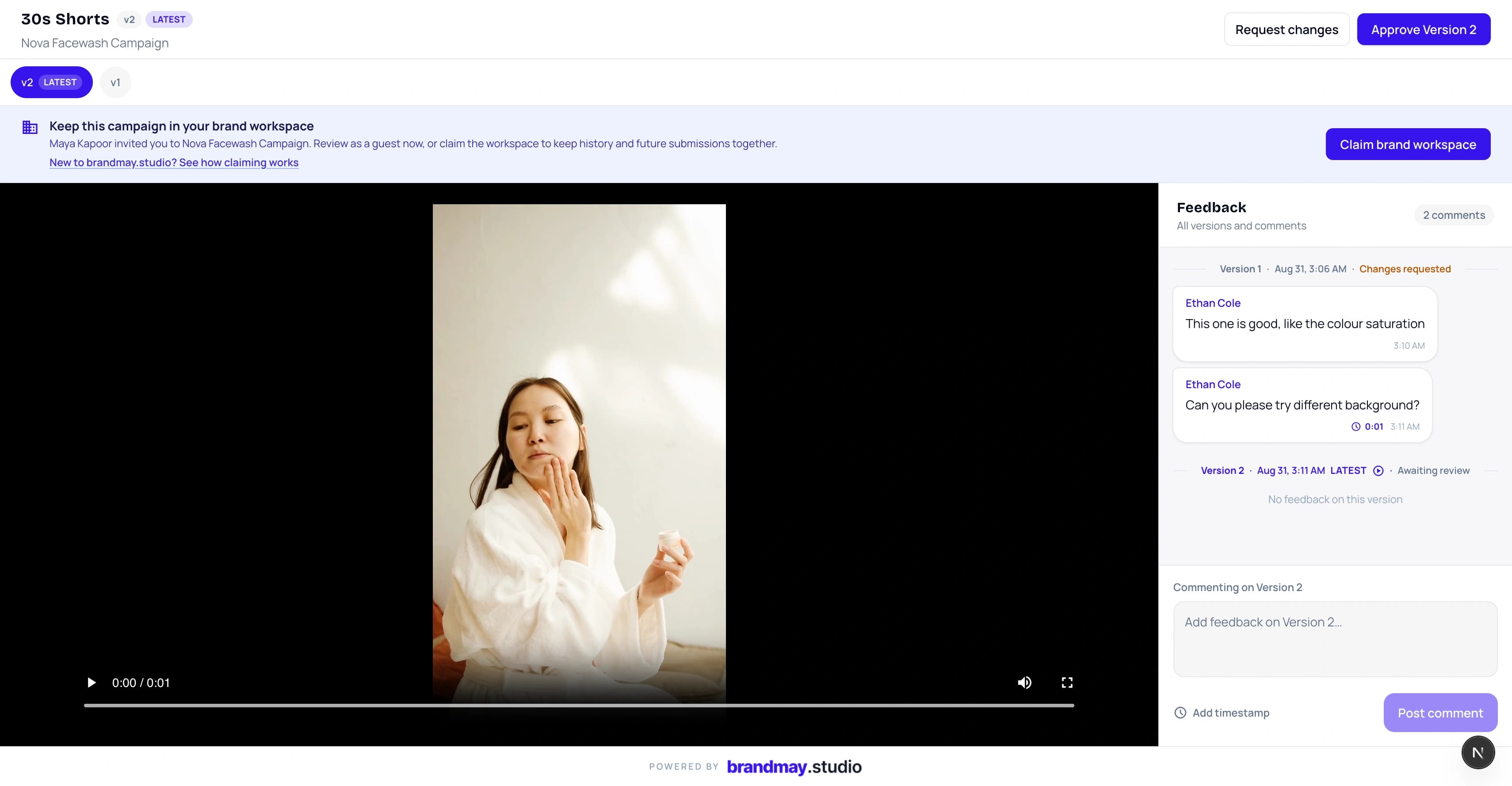
A campaign is not simply “in progress.” One Reel may be approved while two Story frames have not been uploaded.
Track each deliverable through a short, consistent path:
Not started → Draft uploaded → Sent for review → Changes requested or approved → PublishedKeep the latest file, feedback and approval together. If feedback belongs to V2, it should not appear as though it was written on V1.
3. Track money as amounts, not feelings
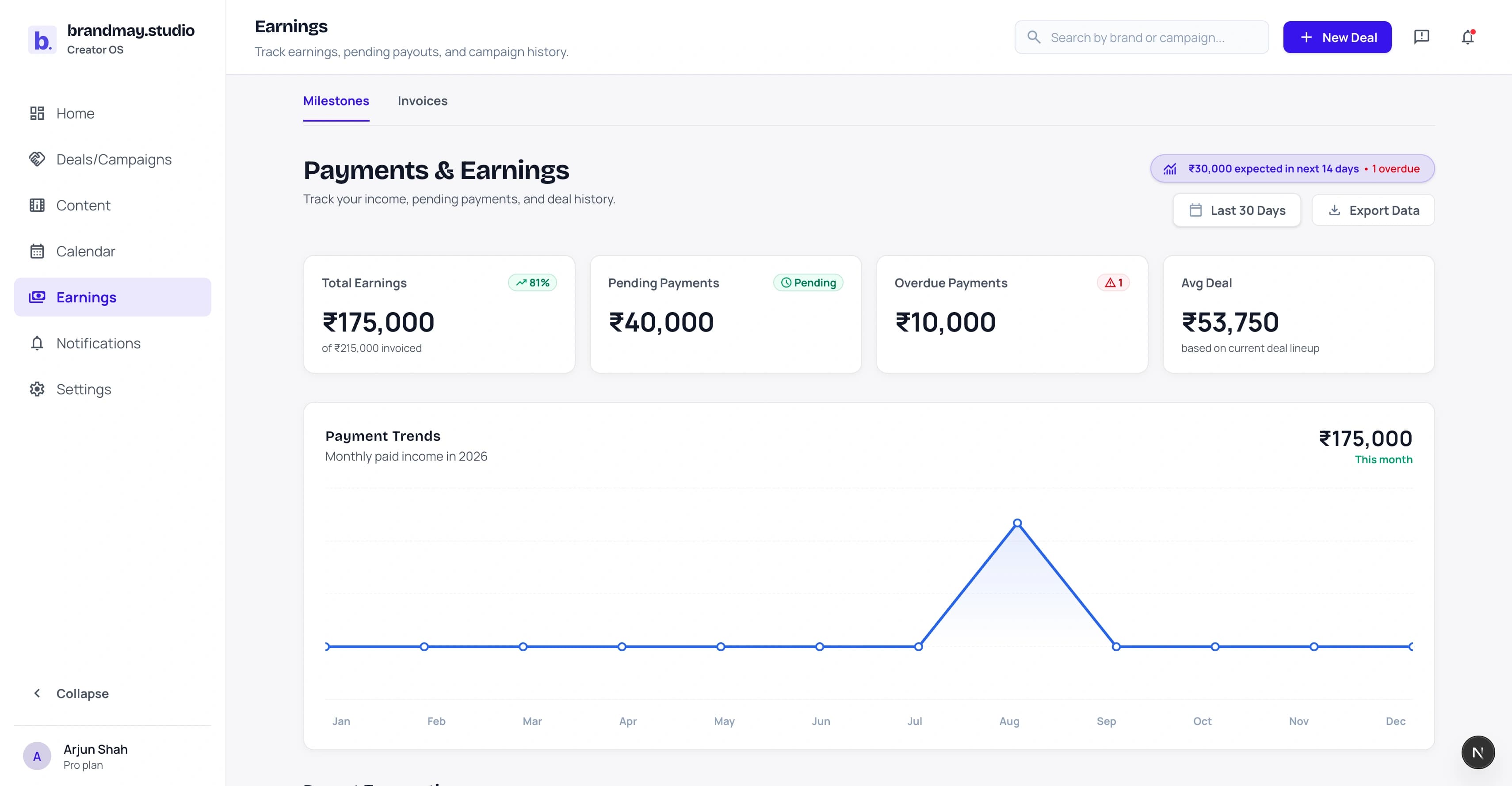
For every payment milestone, store:
- milestone title;
- expected amount;
- amount received so far;
- due date;
- received date;
- invoice or payment proof where relevant.
Then calculate the remaining amount instead of estimating it.
Deal value: ₹30,000
Received: ₹10,000
Remaining: ₹20,000
Next payment: ₹20,000 due 18 September
That summary is more useful than a general “payment pending” label. It tells you what to follow up on and how much is actually outstanding.
4. Keep one next action per deal
Every active collaboration should answer: What should I do next?
Useful next actions are specific:
- Upload Reel V2 by Tuesday.
- Ask the brand to approve the latest draft.
- Send invoice after the post goes live.
- Follow up on ₹20,000 due yesterday.
“In progress” describes a condition. It does not help you act.
5. Review all live deals once a week
Set aside 20 minutes to scan every non-completed campaign.
Check:
- What is due in the next seven days?
- Which deliverable is waiting on you?
- Which deliverable is waiting on the brand?
- Which invoice or payment is due?
- Which detail changed in chat but not in your tracker?
This weekly pass is more valuable than building a perfect dashboard you never update.
Where BrandMay fits
BrandMay applies the same system in one creator workspace.
Campaigns hold the scope, dates, contacts, deliverables and commercial terms. Deliverable workspaces keep draft versions, review links, comments and approvals connected. Earnings views separate received money from the balance that is still due.
The goal is not to replace every conversation. Creators and brands will still talk in WhatsApp, email, or DMs. BrandMay gives the decisions from those conversations a durable place to live.
When a brand asks for an update, you should not need to reconstruct the deal from search results. You should be able to see:
What is due → what do I do next → how much is still unpaid?
Know when your current setup has reached its limit
WhatsApp may still be enough if you have one occasional collaboration and can confidently answer every deadline and payment question.
Consider a dedicated system when:
- two or more collaborations regularly overlap;
- you have sent the wrong draft or searched for approval proof;
- an unpaid balance has disappeared after the content went live;
- a changed deadline exists only in chat;
- checking campaign status takes longer than doing the next task.
The right time to organise your work is before the first expensive mistake, not after it.
Try it with one real collaboration
Do not migrate your entire creator business on day one. Take the next brand deal and record its scope, due dates, draft versions and payment milestones in one place.
If that makes the next action clearer, keep using the system.
Try it with your next brand deal at brandmay.studio.
When you are ready to run this in one place
Try the system with your next brand deal
BrandMay keeps the brief, deliverables, review versions, invoices, and payments connected so the next action is easier to see.